Our Doctor - Jae-Seong Lee, MD, OB-GYN | Aegis Roen HIFU Center




Main menu

Section menu
Page title
A new and effective treatment for uterine fibroids
Page content
Treatment patients trust, results patients are happy with
Full profile: publications, research and HIFU clinical experience →
Social change, fewer births and Western-style diets and lifestyles have led to more women with uterine fibroids and adenomyosis.
Fibroids and adenomyosis are benign conditions that cause many symptoms, such as abnormal bleeding, heavy periods, pelvic pain, period pain, pelvic pressure and frequent urination. They are rarely cancerous, but they can seriously affect health and daily life.
Traditional treatment has been either medication or surgery. Medication is a temporary hormone treatment used to delay surgery. Surgery usually means invasive operations under general anesthesia, such as myomectomy (removing the fibroids) or hysterectomy (removing the uterus).
The uterus matters to women both physically and emotionally, so most women want to keep it. Yet most treatments until now have sacrificed the uterus.
Ultrasound-guided HIFU for fibroids and adenomyosis treats the cause, not just the symptoms like temporary hormone therapy. It avoids general anesthesia and invasive surgery, preserves the uterus, and is a new treatment that removes fibroids effectively while being safer for pregnancy and childbirth than conventional surgery.
Have regular check-ups to find fibroids and adenomyosis early, and treat them with HIFU before they get worse.
- Career
- Former Director, HIFU Center, Department of OB-GYN, Incheon Christian Hospital
- Former HIFU Advisor, Health Insurance Review & Assessment Service (Korea)
- Adjunct Professor, Department of OB-GYN, Inha University College of Medicine
- Adjunct Professor, Incheon St. Mary's Hospital, Catholic University of Korea
- Director, Aegis Roen OB-GYN Clinic
(formerly Aegis Women's Clinic) - Director, International HIFU Training Center
- Memberships
- Member, Korean Society of Obstetrics and Gynecology
- Member, Korean Society of Gynecologic Endocrinology
- Member, Korean Society of Gynecologic Endoscopy
- Jae-Seong Lee, MD, Director
-
Non-surgical treatment
To protect
a woman's uterus, we provide
strictly non-surgical treatment. -
Personalized treatment
Selecting patients who are suitable for HIFU
Recommending the right treatment for each person -
Safe treatment
Through safe and effective
non-invasive HIFU treatment,
restoring uterine health and making pregnancy possible -
Advanced modern medicine
An advanced HIFU treatment for women's conditions,
representing modern medical technology


- 2010. Korea's first OB-GYN to provide HIFU treatment
- 2012. First presentation introducing HIFU at the 98th Korean Society of Obstetrics and Gynecology congress
- 2013. HIFU presentation at the 1st Yangtze International Minimally Invasive & Non-invasive Conference
- 2013. HIFU presentation at the 99th Korean Society of Obstetrics and Gynecology congress
- 2014. HIFU presentation at the Taiwan Association of Obstetrics and Gynecology
- 2014. HIFU presentation at the Taiwan Society of Minimally Invasive Surgery
- 2014. 8th 'Dajia' Ultrasound Therapy Forum
- 2014. HIFU presentation at the 100th Korean Society of Obstetrics and Gynecology congress
- 2014. HIFU presentation at the 2nd Yangtze Minimally Invasive Conference
- 2015. HIFU training at the HIFU Center of Chang Gung Memorial Hospital, Taiwan
- 2015. HIFU presentation at the 30th Asia-Oceania Congress of Obstetrics and Gynecology
- 2015. Paper published in Ultrasonics Sonochemistry (SCI): “Ultrasound-guided high-intensity focused ultrasound treatment for uterine fibroid & adenomyosis”
- 2015. HIFU presentation at the 101st Korean Society of Obstetrics and Gynecology congress
- 2015. HIFU presentation at the 2nd Yangtze Minimally Invasive & Non-invasive Conference
- 2015. HIFU presentation at the 21st FIGO World Congress of Gynecology and Obstetrics
- 2015. HIFU presentation at ACTA, Japan
- 2015. HIFU presentation at CFOG, Taiwan
- 2015. HIFU presentation at the 11th MizMedi Hospital Symposium
- 2016. Paper published in Journal of Korean Medical Science (IF 1.256): “Effects of High-Intensity-Focused Ultrasound Treatment on Benign Uterine Tumor”
- 2016. Paper published in Obstetrics & Gynecology Science: “High-intensity focused ultrasound combined with hysteroscopic resection to treat retained placenta accreta: A Case Report”
- 2016. HIFU presentation at the 102nd Korean Society of Obstetrics and Gynecology congress
- 2016. HIFU presentation at the 2nd Korean Society of Therapeutic Ultrasound meeting
- 2017. Paper accepted in Ultrasonics Sonochemistry (IF 4.556) “Unintended Pregnancie
- 2017. Research presented at the 103rd Korean Society of Obstetrics and Gynecology congress
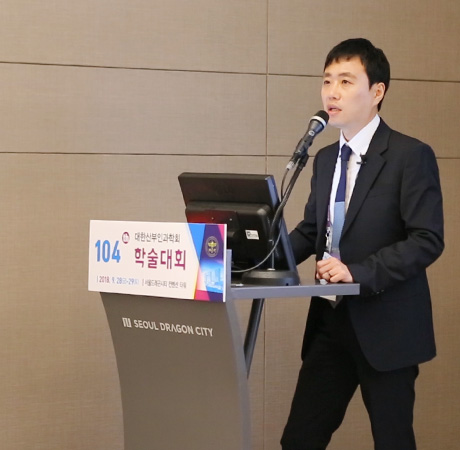
- 2018. Research presented at the 104th Korean Society of Obstetrics and Gynecology congress
- 2021. Research presented at the 107th Korean Society of Obstetrics and Gynecology congress
published in international journals Ultrasound-guided high-intensity focused ultrasound treatment for uterine fibroid & adenomyosis: A single center experience from the Republic of Korea. (Ultrason Sonochem. 2015 Nov;27:682-7. doi: 10.1016/j.ultsonch.2015.05.033. Epub 2015 May 27.)
OBJECTIVES: This study aimed to assess the therapeutic outcomes of patients with uterine fibroid or adenomyosis treated by ultrasound-guided high-intensity focused ultrasound (USgHIFU) ablation at Incheon Christian Hospital, Korea.
METHODS: This study included 618 patients, of which 272 suffered from uterine fibroid and 346 suffered from adenomyosis. Treatment was administrated using the Model Haifu JC Focused Ultrasound Tumor Therapeutic System (Chongqing Haifu Technology, Chongqing, China) under real-time ultrasound guidance. A follow-up was conducted on volume change as well as on symptom improvement using the Symptom Severity Score (SSS) and Uterine Fibroid Symptom and Quality of Life (UFS-QOL) after treatment.
RESULT: The uterine fibroid volume reduction rates (%) were 58.08%, 66.18%, and 77.59% at 3, 6, and 12 months after treatment, respectively. The SSS reduction rates (%) were 55.58%, 52.76%, and 50.39% by 3, 6, and 12 months, respectively. The UFS-QOL score increasing rates (%) were 42.66%, 43.50%, and 43.45% by 3, 6, and 12 months, respectively. The uterine volume reduction rates (%) for adenomyosis were 43.99%, 47.01%, and 53.98% by 3, 6, and 12 months, respectively. The SSS reduction rates (%) for adenomyosis were 55.61%, 52.38%, and 57.98% by 3, 6, and 12 months, respectively. The UFS-QOL score increasing rates (%) for adenomyosis UFS-QOL score were 80.06%, 69.39%, and 85.07% by 3, 6, and 12 months, respectively.
CONCLUSION: We conclude that USgHIFU treatment for uterine fibroid and adenomyosis is an effective non-invasive therapy via the assessment of fibroid volume reduction, symptom improvement, UFS-QOL score increase, and acceptable level of side effects. Although preliminary experience of HIFU is encouraging, well-designed prospective trials and more clinical experiences are needed to ascertain the efficacy and safety of this new treatment.
Effects of High-Intensity-Focused Ultrasound Treatment on Benign Uterine Tumor. (J Korean Med Sci. 2016 Aug;31(8):1279-83. doi: 10.3346/jkms.2016.31.8.1279. Epub 2016 Jun 7.)
In this study, the effects of high-intensity-focused ultrasound (HIFU) treatment on benign uterine tumor patients were examined. A total of 333 patients diagnosed with fibroids or adenomyosis using diagnostic sonography, treated with HIFU between February 4, 2010 and December 29, 2014 at a hospital in Korea, and followed up for three or six months were selected for this study. Their benign uterine tumor volume was measured, and the effects of HIFU treatment on the volume were analyzed according to age, disease, fertility, and treatment duration. The volume of benign tumors of the uterus changed by age in all age groups after conducting HIFU treatment for 3 and 6 months, respectively. The rate of decrease in individuals' in their twenties was the largest, at 64.9%. When the decreasing volume of benign tumors of the uterus was analyzed by type of disease, the treatment efficacy for adenomyosis was the best, with a decrease of 164.83 cm(3) after 6 months. Myoma had the fastest decreasing rate, at 68.5%.
When evaluated on the basis of fertility, the volume of benign tumors of the uterus continued to decrease until 6 months after completing all procedures. The volume has continued to decrease for 6 months after all procedures. This study showed that HIFU treatments for uterine fibroid and adenomyosis is an effective non-invasive therapy via reducing the benign uterine tumor volume.
Therefore, the HIFU method might replace other conventional treatment methods.
High-intensity focused ultrasound combined with hysteroscopic resection to treat retained placenta accreta. (Obstet Gynecol Sci. 2016 Sep;59(5):421-5. doi: 10.5468/ogs.2016.59.5.421. Epub 2016 Sep 13.)
We present a case of retained placenta accreta treated by high-intensity focused ultrasound (HIFU) ablation followed by hysteroscopic resection. The patient was diagnosed as submucosal myoma based on ultrasonography in local clinic. Pathologic examination of several pieces of tumor mass from the hysteroscopic procedure revealed necrotic chorionic villi with calcification. HIFU was performed using an ultrasound-guided HIFU tumor therapeutic system. The ultrasound machine had been used for real-time monitoring of the HIFU procedure. After HIFU treatment, no additional vaginal bleeding or complications were observed. A hysteroscopic resection was performed to remove ablated placental tissue 7 days later. No abnormal vaginal bleeding or discharge was seen after the procedure. The patient was stable postoperatively. We proposed HIFU and applied additional hysteroscopic resection for a safe and effective method for treating retained placenta accreta to prevent complications from the remaining placental tissue and to improve fertility options.
treatment research presented 2012–2021: HIFU research published in international journals and regularly invited to speak at conferences in Korea and abroad
-
2012 'Invited lecture, 98th Korean Society of Obstetrics and Gynecology congress'
'A new option for treating uterine fibroids and adenomyosis: ultrasound-guided high-intensity focused ultrasound ablation'
-
2013 '99th Korean Society of Obstetrics and Gynecology congress'
Successful Pregnancy and Term Delivery Following Ultrasound-Guided High-Intensity Focused Ultrasound (USgHIFU) Surgery of adenomyosis and uterine leiomyoma: cases report
-
2014 '100th Korean Society of Obstetrics and Gynecology congress'
Ultrasound-guided High-Intensity Focused Ultrasound Treatment for Uterine Fibroid & Adenomyosis : A Single Center Experience
-
2015 '101st Korean Society of Obstetrics and Gynecology congress'
Ultrasound-guided High-Intensity Focused Ultrasound Treatment for Uterine Fibroid & Adenomyosis Successful Pregnancy with Term Delivery Following Ultrasound-Guided High-Intensity Focused Ultrasound (USgHIFU) Ablation
-
2016 '102nd Korean Society of Obstetrics and Gynecology congress'
Changes in antimullerian hormone levels as a biomarker of ovarian reserve after ultrasound-guided high- intensity focused ultrasound treatment of adenomyosis and uterine fibroid
-
2017 '103rd Korean Society of Obstetrics and Gynecology congress'
Treatment results based on 1,800 HIFU cases
-
2018 '104th Korean Society of Obstetrics and Gynecology congress'
Treatment results based on 2,000 HIFU cases
-
2021 '107th Korean Society of Obstetrics and Gynecology congress'
12 years of HIFU treatment experience
Consultation menu
Family sites



Awards
Social media

(Seolleung Station Exit 6, Line 2 / Suin-Bundang Line) Tel: +82-2-542-0100 ┃ Business Registration No. 106-91-90905 Representative: Jae-Seong Lee